Dance

The Moon-dancer: Solar Eclipse

A piece of sky beside the crescent sun was detaching. It was a loosened circle of evening sky, suddenly lighted from the back. It was an abrupt black body out of nowhere; it was a flat disk; it was almost over the sun. That is when there were screams. At once this disk of sky slid over the sun like a lid. The sky snapped over the sun like a lens cover… The eyes dried, the arteries drained, the lungs hushed. There was no world. We were the world’s dead people rotating and orbiting around and around, embedded in the planet’s crust, while the earth rolled down. — Annie Dillard, “Total Eclipse.”

K. Partridge: Movement Director
Luscinda L. Dickey: Dancer
Carrie Leigh Dickey: Costume and Hair, Cinematographer and Video Editor

The Inspiration:

solar eclipse noun
: an eclipse of the sun by moon

In other words, when the lesser of the great lights overcomes the mightier. Bringing darkness. Darkness and stillness where there should be brilliance.

The moon is bound to Earth, as most of us are. It is even thought to be made of Earth: of rock and metal and dust—just as we are all made of Earth. The moon has become a symbol of our loves, our fears, our dreams, our hopes, our time, our memories, our changes, our unknowns, and even of our certainties. The moon will always pass through its phases: the tides will always come in and go out. Yet truly, the moon makes no light: it merely reflects the sun.

The sun is not bound to Earth or made of Earth—Earth is bound to the sun. The sun is fire and fusion. Scalding, burning, rippling, incomprehensible power. Its light is ancient—it may take thousands of years for a single photon to traverse from the sun’s core to our skin. The sun is 99% of this solar system. Earth is 0.0003%. The sun rules how life is and that it canbe. The sun is a thing of majesty, of energy, of constancy, of survival.

Strange, don’t you think, that one day, about five billion years in the future—if this universe continues flashing through fantastic blackness for that long—something in the sun will lightly click and that great ball of fusion, now massive and red, will collapse? Poof! Its outer layers will be ejected into a glimmering, rainbow-like, planetary nebula; and the rest of the sun will compress into a little white dwarf which will slowly dwindle out into nothing. 

Darkness. Stillness. 

A stillness like we feel when—for one fleeting moment—chilly dusk descends at noon, shadows split, and the wind grows silent as the crickets mourn. 

For one fleeting moment, the beloved Earth-bound symbol of humanity conquers the majestic champion of all life.

For one fleeting, breathtaking moment, the sun is eclipsed.

The Music: 

Erik Satie’s Gnossienne No 3.

Dance

The Moon-dancer: Full Moon

I think, that if I touched the earth, It would crumble; It is so sad and beautiful, So tremulously like a dream. —from “Clown In The Moon

K. Partridge: Movement Director
Luscinda L. Dickey: Dancer
Carrie Leigh Dickey: Costume and Hair, Cinematographer and Video Editor

The Inspiration:

“Votre âme est un paysage chosi.”
Your soul is a chosen landscape.
On which masques et Bergamasques cast enchantment as they go…
They roam. Bewitching. Charming.
“Charmant.”
…Playing the lute, and dancing, and almost
Sad beneath their whimsical, fanciful, fantastic
“déguisements fantasques.”

“Tout en chantant sur le mode mineur
L’amour…” of love.
All-conquering love; life so kind. Victorious and opportune.
They do not seem to believe their happiness
“Et leur chanson se mêle au clair de lune.”

Light of the moon—calm, sad, beautiful—
Which sets the birds rêver in the trees.
And the plumes of the fountains weep,

Sob,

D’extase—in rapture—

Ecstasy.

Among the marble sculptures.

“Les grands jets d’eau sveltes parmi les marbres.”

Me, I wandered alone, walking my wound.
“Promenant me plaie.”
Through willow grove; the length of the pound
Where the vague mist conjured some vast
“Fantôme laiteux se désespérant”

With the voice crying…

As they called to each other, beating their wings
Through the willow grove where alone I wandered
Walking my wound; and the thick shroud
Of shadows came to drown…

Clair de lune—calm, triste, and beautiful.
Masques et Bergamasques cast enchantment…
As they go.
Quasi Tristes…
Un paysage choisi…

Your Soul.

— Two Fragmented Poems by Paul Verlaine

The Music: 

Claude Debussy’s “Clair de lune” from Suite bergamasque; transposed for celesta.

Dance

The Moon-dancer: First Quarter

With this dance, may your wishes for wisdom, balance, creativity, loyalty, peace, persistent love, and longevity be granted.

K. Partridge: Movement Director
Luscinda L. Dickey: Dancer
Carrie Leigh Dickey: Costume and Hair, Cinematographer and Video Editor

The Inspiration:

Once there was a young Rabbit. Each night he would stare longingly at the moon—so far above him! But the Rabbit knew he could fly there if only he had the wings. So, the Rabbit went to all the great birds—the clever ravens and jays, the flocking geese, the calling loons, even the majestic eagles—and he asked them: “Will not one of you take me to the moon?” But they all scoffed at the Rabbit. None of them would agree to fly him to the moon no matter how he reasoned and wheedled. 

And then a bird said: “I will take you!” It was the Crane—a dull grey and white bird with short little legs and a thin, tall neck. “Hold onto my legs tightly,” said the Crane as it opened its wings, “It is a long, long way to the moon, and you mustn’t fall off.”

It was a long way to the moon! The Rabbit clung to the Cranes legs with all his might even though gripping so tightly made his paws raw and bloody. The Crane kept flying, even though the Rabbit was a very heavy burden for it to carry—so heavy, in fact, that the Crane’s legs were stretched longer and longer as the moon grew closer and closer… This is why cranes have long, long legs.

Finally, the Crane set the Rabbit down on the white surface of the moon. Overwhelmed by thankfulness, the Rabbit touched the Crane’s head with his bloody paw leaving a stain of red… This is why cranes have heads crowned with scarlet.

Happy to have fulfilled the dreams of another, the now transformed Crane flew back to Earth leaving the Rabbit. To this day, on a clear, bright night, you can still see the Rabbit riding the moon. — Telling of a Cree Legend 

The Music: 

Amy Beach’s “Dreaming,” Four Sketches, Op. 15, No. 3; arranged by the composer for piano and cello.

Dance

The Moon-dancer: Waxing Gibbous

“‘Here it is,’ he said, and waved his hands towards the water below. A soft glow shone from the reflections on the lake bathing them all in light. ‘…a Luminous Stone That Lights the Night.’”—When the Sea Turned to Silver, by Grace Lin

K. Partridge: Movement Director
Luscinda L. Dickey: Dancer
Antonel Neculai: Drone Footage
Carrie Leigh Dickey: Costume and Hair, Cinematographer and Video Editor

The Inspiration:

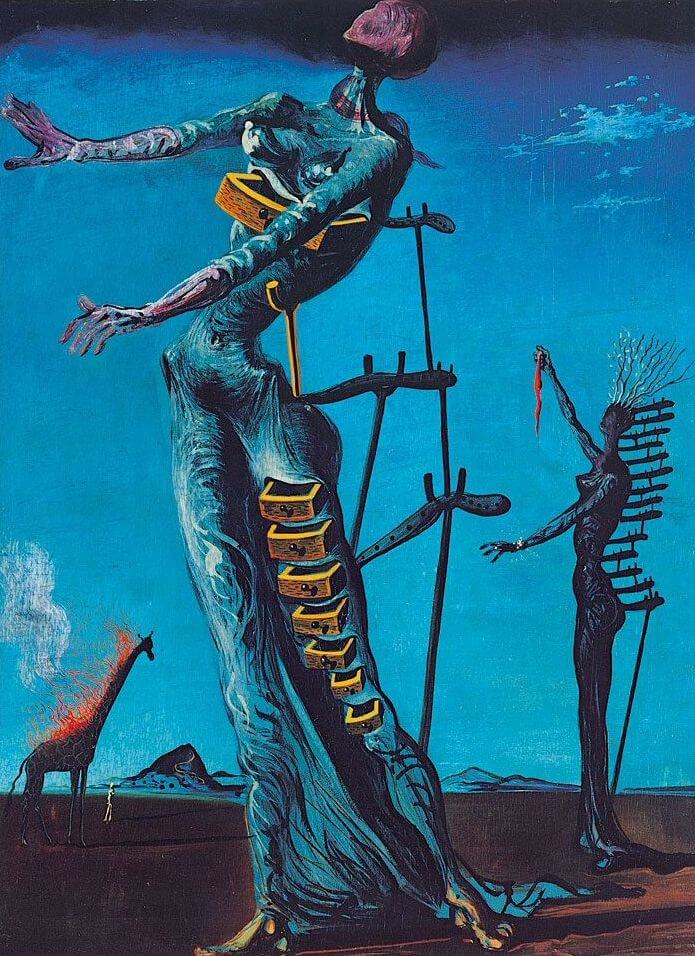
Are we up or down? Here or there? Then or now? Asleep or awake? Conscious or subconscious? Are we really floating somewhere in between? Surrealism is full of questions. The answers always depend on your perspective.

In Grace Lin’s book When the Sea Turned to Silver, Pinmei, the shy grand-daughter of a story teller, and Yishan, a young boy with immortal wisdom, journey to the bottom of the ocean in search of the tear of a goddess: a “Luminous Stone That Lights the Night.” The Sea King takes them across a bridge—one that “…stretched and stretched only to disappear…”

“‘Are we walking over the sea?’ Pinmei asked faintly.

“‘This is the Heavenly Lake,’ the Sea King told her. ‘The immortals of the sky call it the Celestial River and you mortals call it the Starry River, but here we call it the Heavenly Lake. I suppose to us at Sea Bottom, it seems more the size of a lake than a river.’

“‘But the Starry River is in the sky,’ Pinmei said, shaking her head in confusion. ‘It’s up high. This is below!’

“The Sea King nodded. ‘Our worlds connect here,’ he said. ‘The bottom of the Heavenly Lake is your sky.’

“…After another long pause, the Sea King stopped and brought them to the edge of the bridge.

“‘Here it is,’ he said, and waved his hands towards the water below. A soft glow shone from the reflections on the lake bathing them all in light. ‘…a Luminous Stone That Lights the Night.’

Or, Pinmei thought as she stared downward, the moon.”

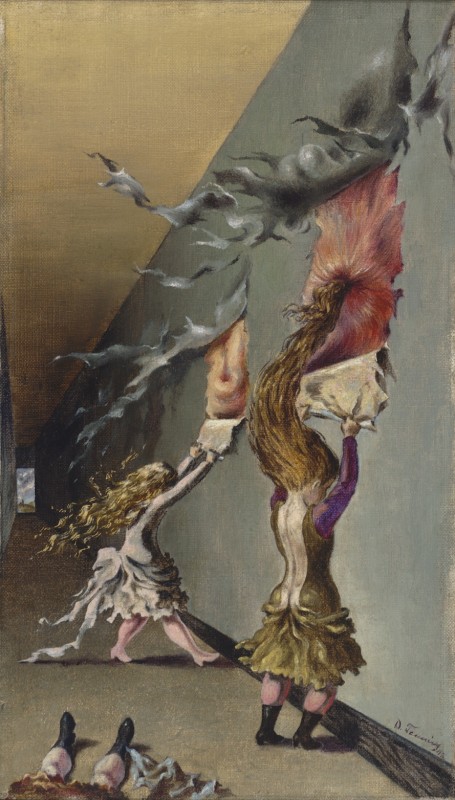
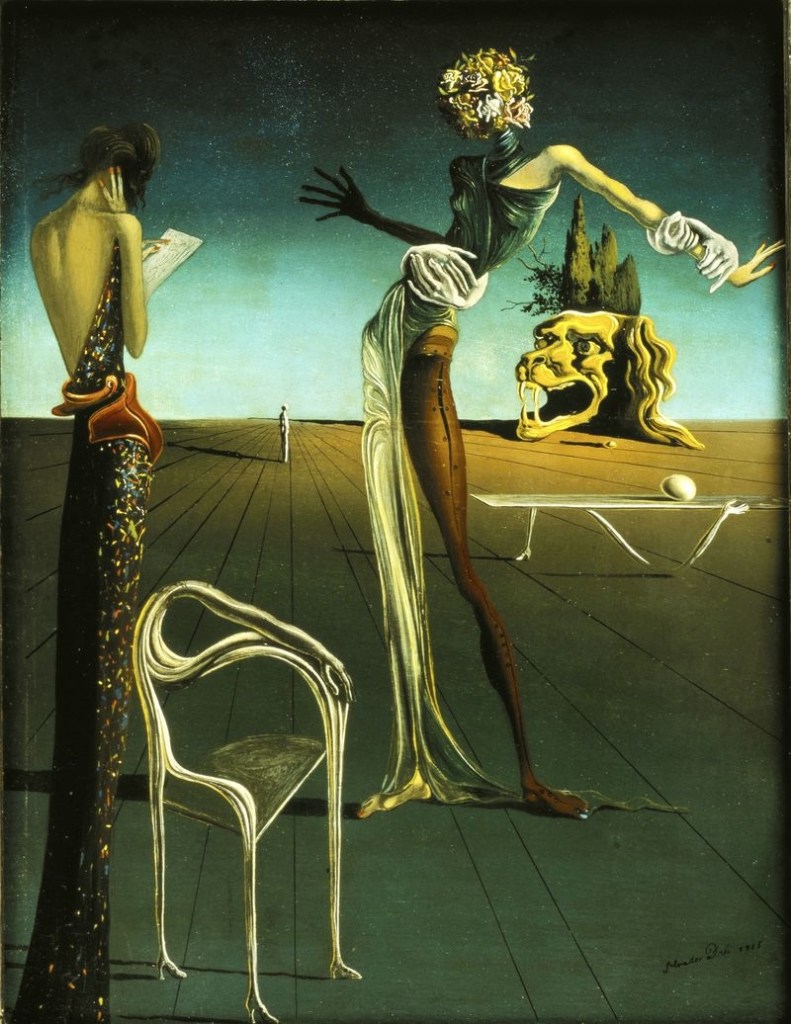
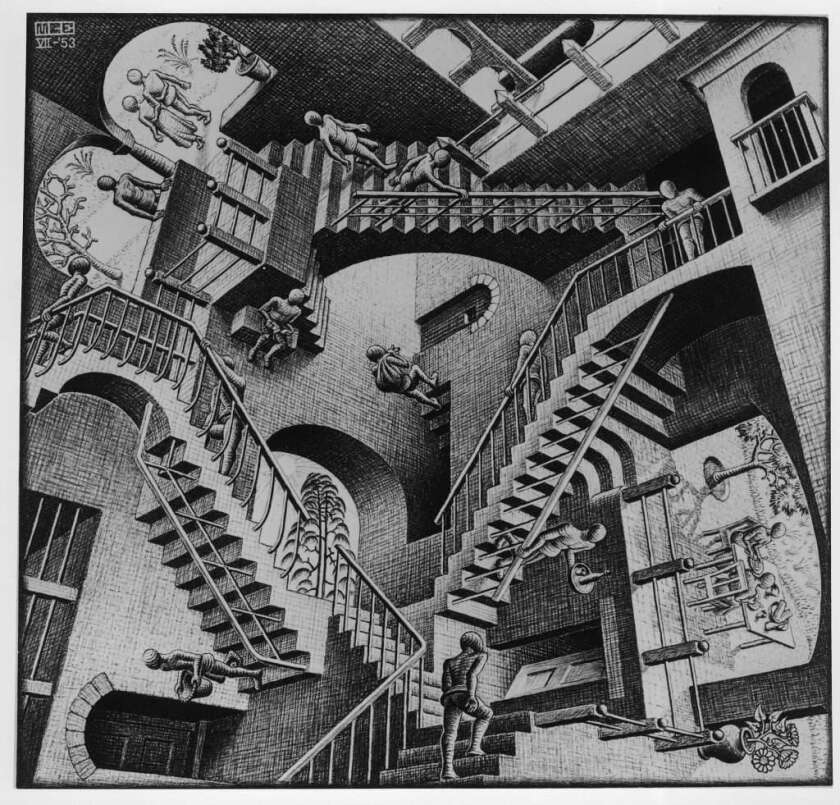
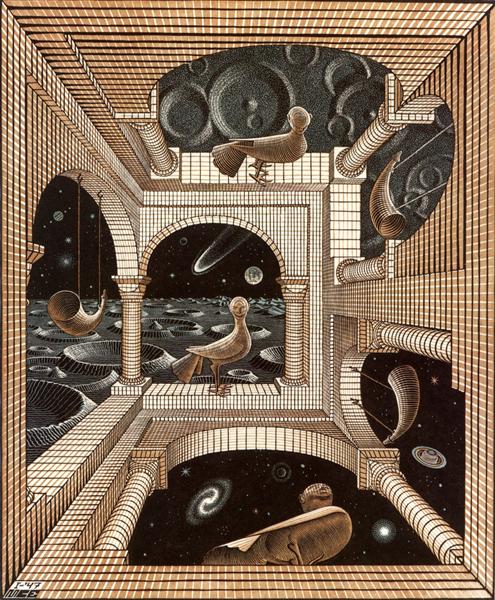
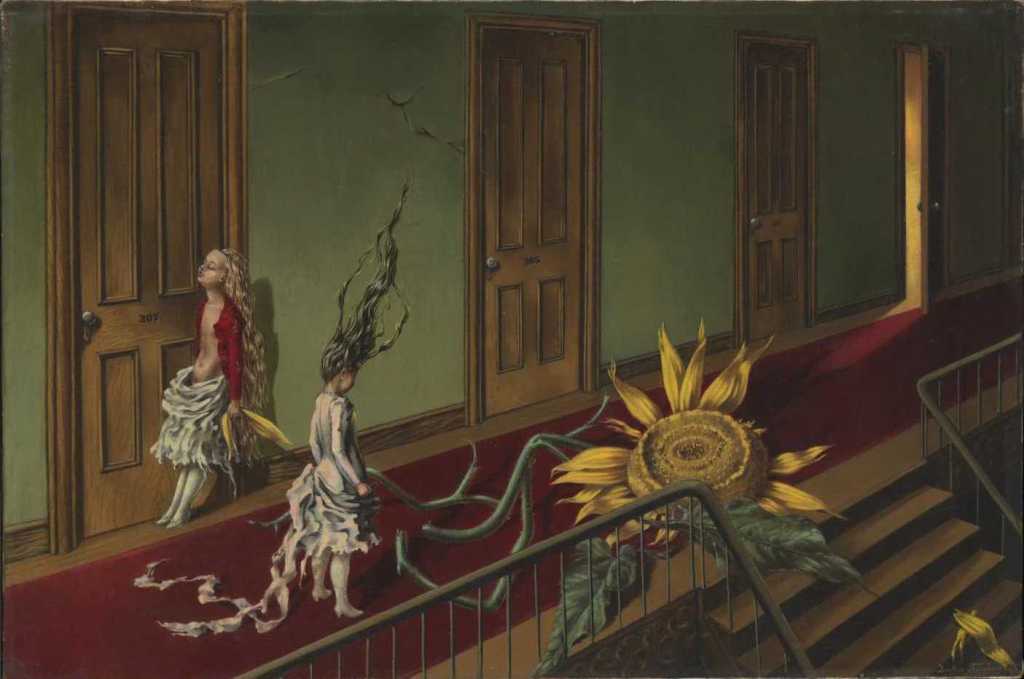
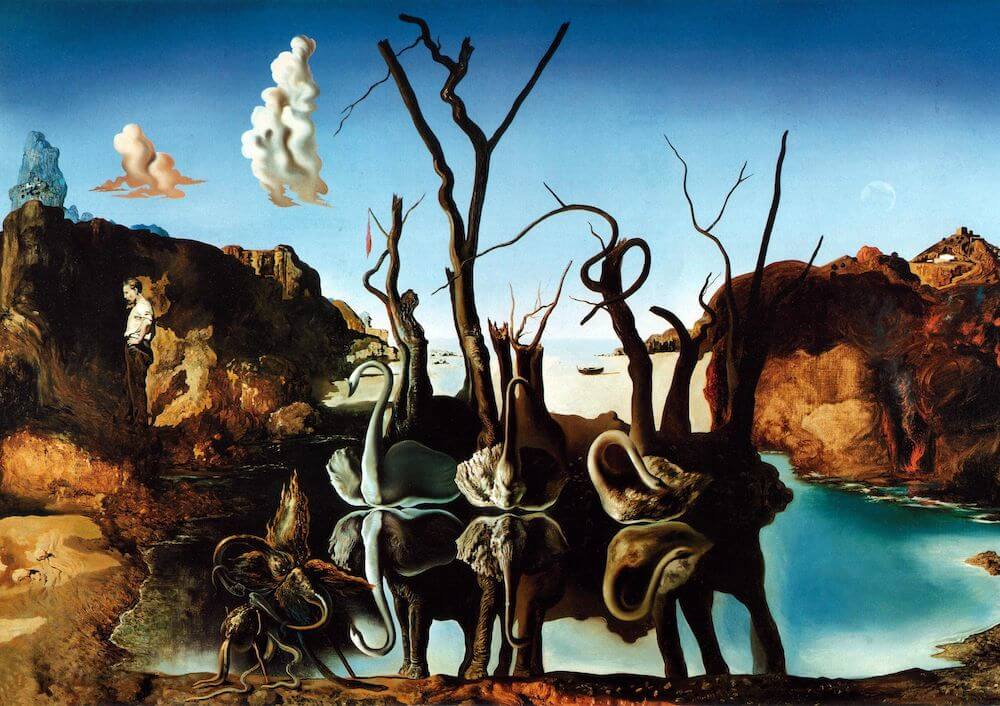
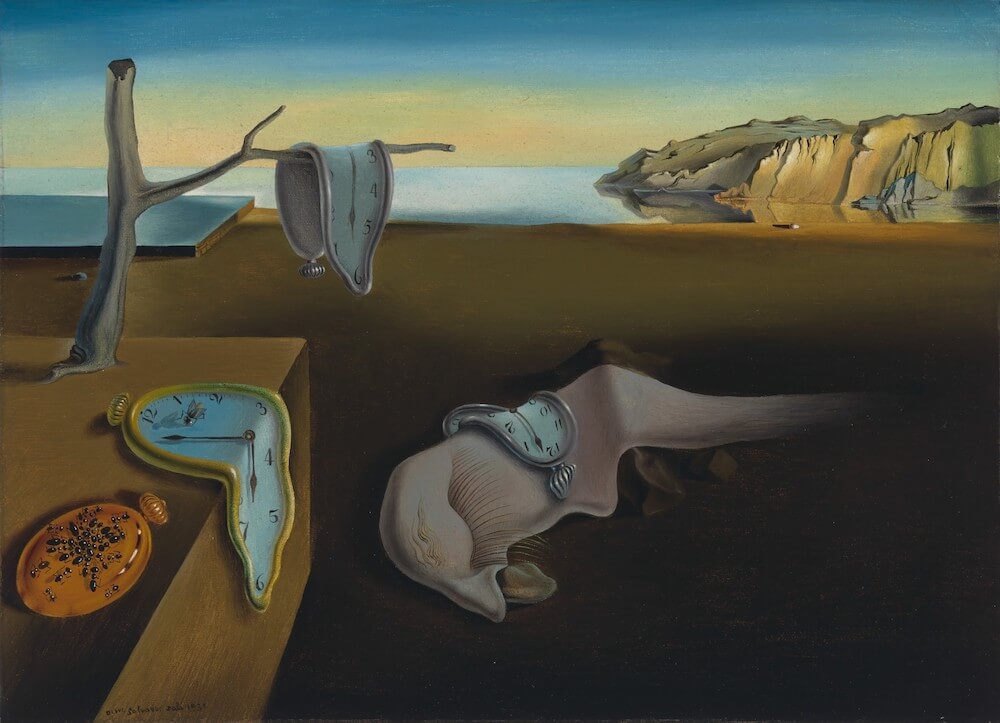
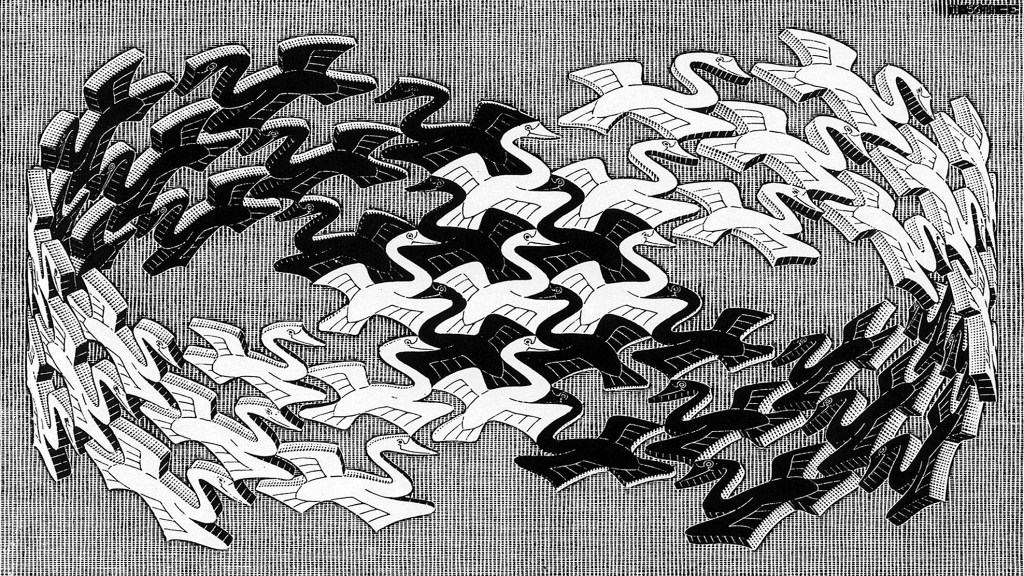
The Moon-dancer: Waxing Gibbous was inspired by the works of Surrealist artists Salvador Dali, M. C. Escher, and Dorothea Tanning.


The Music: 

Erik Satie’s Gymnopédie No. 1—Lent et douloureux, as orchestrated by Claude Debussy.

The Composer and the Orchestrater:

After leaving his position at Le Chat Noir, Erik Satie became second pianist at Auberge du Clou. It was there, in 1890, that he first met Claude Debussy. Finding that they shared a passion for experimental composition, the two bohemians struck up a relationship that would last for years. Can you imagine an afternoon at Debussy’s flat—a quirky place, with a balcony only big enough for two or three flower pots, high up in the Paris sky? I can see Debussy perched at his rather out-of-tune old piano and exuberantly playing Satie his newest idea, as the latter leans back in a rickety arm chair while sipping happily on a glass of cheap and slightly dusty wine. It was in 1897 that Debussy, whose popularity was growing as Satie’s was waning, helped put his friend back into the public eye by orchestrating two of the now famous Gymnopédies.

Dance

The Moon-dancer: Lunar Eclipse

The Tswana people in Africa believe that a lunar eclipse is when a lion blocks the light of the moon with his paw so that he can hunt more successfully.

K. Partridge: Movement Director
Luscinda L. Dickey: Dancer
Carrie Leigh Dickey: Costume and Hair, Cinematographer and Video Editor

The Inspiration:

“I find that unexpected color juxtapositions create a kind of emotional drama—at times harmonious, at others contentious,” writes Mr. Frank Campion, an abstract artist based just outside of Winston-Salem, NC.

This dance was created in response to Mr. Campion’s work. Choreographed with a combination of Afro-Cuban dance—inspired his art’s raw, gritty marks and poured paint, and Fosse influenced jazz—inspired by his art’s bold color and crisp angles, it is meant to embody “…the tension that can exist between logical, deliberate, geometric forms and irrational, accidental painterly incident.”

The Music: 

Erik Satie’s Gnossiennes No. 1

The Composer:

Imagine you could time-travel back to Paris in the late 1800s. It is a late, chilly, fall evening in Montmartre. You are strolling along the Boulevard towards the glowing windows of Le Chat Noir cabaret. You slip in the door through a crowd of Club des Hydropathes members, squeeze behind a corner table, and order your favorite drink.

Many voices talk at once over the piano music—about poetry, painting, the theatre, bohemian society. No one pays much attention to the pianist, but you hang onto every chord he plays. This eccentric looking young man in a black frock coat is Erik Satie: a composer who broke the boundaries of music as it was known and went on to help inspire a new generation of composers.

Satie sways softly to the repetitive beat of his tune. He doesn’t look down at his hands, but straight in-front of himself as if seeing the dream-scape of sound he creates—measuring each note. When the piece is finished, you jump up and make your way to the piano. “Monsieur Satie, what a beautiful piece of music!” you cry in your very best French, “What is it called?” Satie turns towards you adjusting his spectacles. “A Gnossiennes,” he says. “And what exactly is a Gnossiennes?” you ask breathlessly. Satie pauses. You catch a slight twinkle in his eye. “A Gnossiennes,” he says very slowly, “is what I just played.” And turning back to the piano, he begins to play once more.