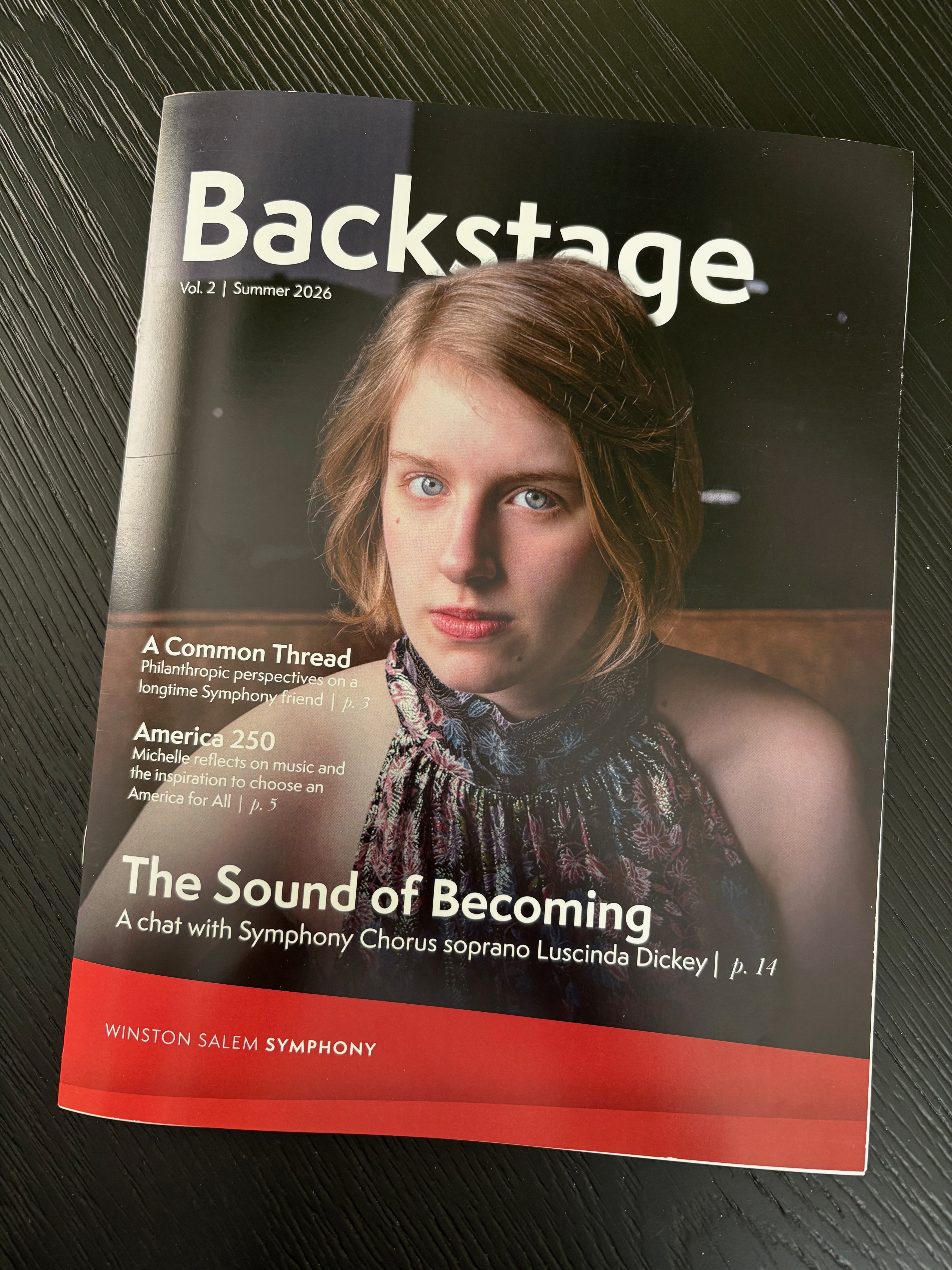
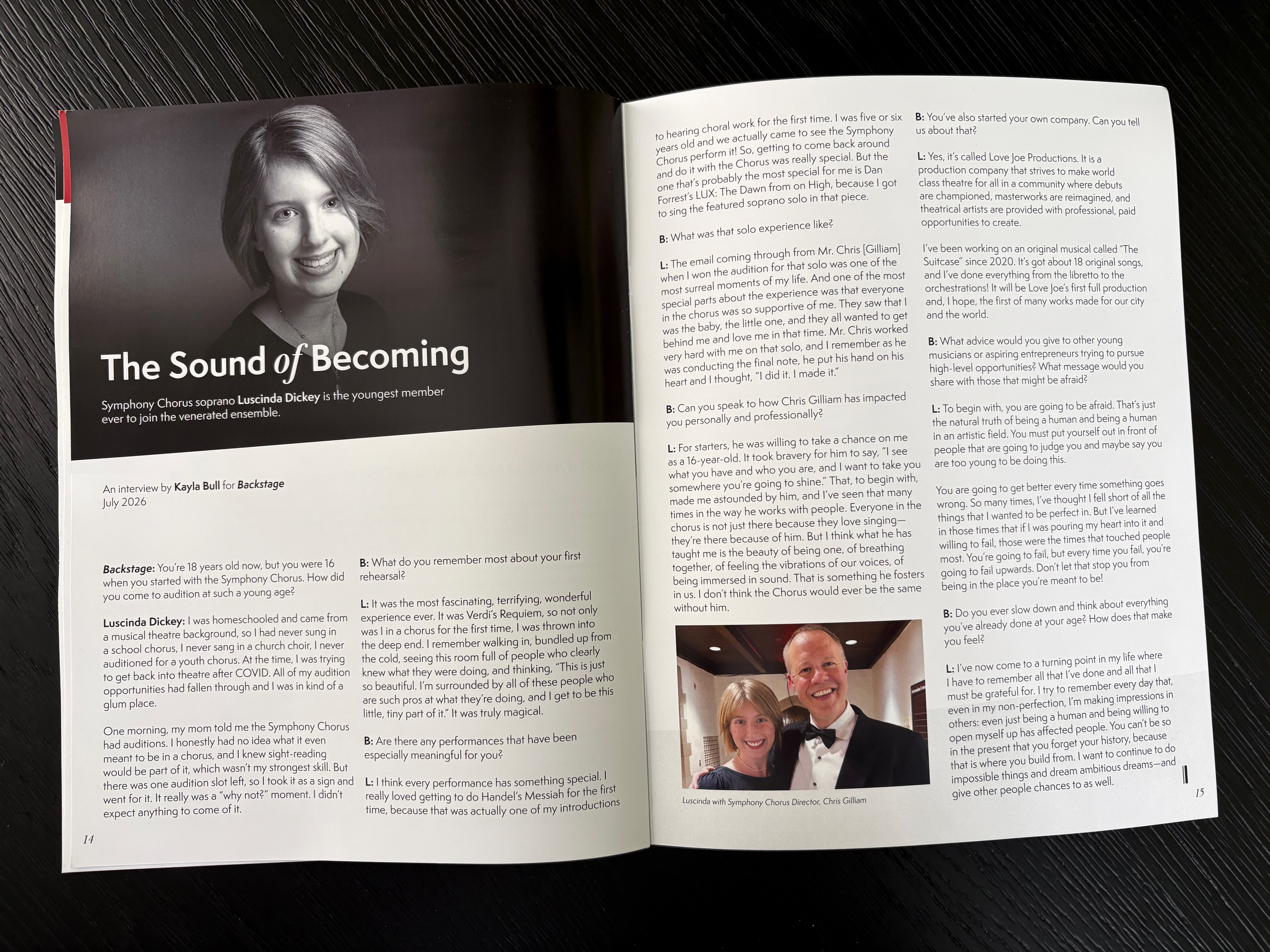
An interview by Kayla Bull of Luscinda L. Dickey for the Winston-Salem Symphony’s Backstage magazine
July 2026
Backstage: You’re 18 years old now, but you were 16 when you started with the Symphony Chorus. How did you come to audition at such a young age?
Luscinda Dickey: I was homeschooled and came from a musical theatre background, so I had never sung in a school chorus, I never sang in a church choir, I never auditioned for a youth chorus. At the time, I was trying to get back into theatre after COVID. All of my audition opportunities at the time had fallen through and I was in kind of a glum place.
One morning, my mom told me the Symphony Chorus had auditions. I honestly had no idea what it even meant to be in a chorus, and I knew sight-reading would be part of it, which wasn’t my strongest skill. But there was one audition slot left, so I took it as a sign and went for it. It really was a “why not?” moment. I didn’t expect anything to come of it.
B: What do you remember most about your first rehearsal?
L: It was the most fascinating, terrifying, wonderful experience ever. It was Verdi’s Requiem, so not only was I in a chorus for the first time, I was thrown into the deep end. I remember walking in, bundled up from the cold, seeing this room full of people who clearly knew what they were doing, and thinking, “This is just so beautiful. I’m surrounded by all of these people who are such pros at what they’re doing, and I get to be this little, tiny part of it.” It was truly magical.
B: Are there any performances that have been especially meaningful for you?
L: I think every performance has something special. I really loved getting to do Handel’s Messiah for the first time, because that was actually one of my introductions to hearing choral work from the audience. I was five or six years old at the time, and we actually came to see the Symphony Chorus perform it! So, getting to come back around and do it with the Chorus was really special. But the one that’s probably the most special for me is Dan Forrest’s LUX: The Dawn from on High, because I got to sing the featured soprano solo in that piece.
B: What was that solo experience like?
L: The email coming through from Mr. Chris [Gilliam] when I won the audition for that solo was one of the most surreal moments of my life. And one of the most special parts about the experience was that everyone in the chorus was so supportive of me. They saw that I was the baby, the little one, and they all wanted to get behind me and love me in that time. Mr. Chris worked very hard with me on that solo, and I remember as he was conducting the final note, he put his hand on his heart and I thought, “I did it. I made it.”
B: Can you speak to how Chris Gilliam has impacted you personally and professionally?
L: For starters, he was willing to take a chance on me as a 16-year-old. It took bravery for him to say, “I see what you have and who you are, and I want to take you somewhere where you’re going to shine.” That, to begin with, made me astounded by him, and I’ve seen that many times in the way he works with people. Everyone is the chorus is not just there because they love singing—they’re there because of him. But I think what he has taught me is the beauty of being one, of breathing together, of feeling the vibrations of our voices, of being immersed in sound. That is something he fosters in us and makes us adore. I don’t think the Chorus would ever be the same without him.
B: You’ve also started your own company. Can you tell us about that?
L: Yes, it’s called Love Joe Productions. It is a production company that strives to make world class theatre for all in a community where debuts are championed, masterworks are reimagined, and theatrical artists are provided with professional, paid opportunities to create.
I’ve been working on an original musical called “The Suitcase” since 2020. It’s got about 18 original songs, and I’ve done everything from the libretto to the orchestrations! It will be Love Joe’s first full production and, I hope, the first of many works made for our city and the world.
B: What advice would you give to other young musicians or aspiring entrepreneurs trying to pursue high-level opportunities? What message would you share with those that might be afraid?
L: To begin with, you are going to be afraid. That’s just the natural truth of being a human and being a human in an artistic field, where you must put yourself out in front of people that are going to judge you and maybe say you are too young to be doing this.
You are going to get better every time something goes wrong. So many times, I’ve thought I fell short of all the things that I wanted to be perfect in. But I’ve learned in those times that, if I was pouring my heart into it and willing to fail, those were the times that touched people most. You’re going to fail, but every time you fail, you’re going to fail upwards. Don’t let that stop you from being in the place you’re meant to be!
B: Do you ever slow down and think about everything you’ve already done at your age? How does that make you feel?
L: I’ve now come to a turning point in my life where I have to remember all that I’ve done and all that I must be grateful for. I try to remember every day that, even in my non-perfection, I’m making impressions in others: even just being a human and being willing to open myself up has affected people. You can’t be so in the present that you forget your history, because that is where you build from. I want to continue to do impossible things and dream ambitious dreams—and give other people chances to as well.

